June 2009 Archives

Comsec's Cootys Rat Semen

| No TrackBacks

I've been a CommSec client for a touch over 8 years now. Recently I signed up for their Cash Management Account which combines a regular transaction account with a high interest savings account, and a debit MasterCard.

What confuses me about their setup is that before I signed up for their CMA I had just one client ID and password to login to both my trading & margin lending accounts. After signing up for CMA I have a new client ID and password to login to the cash management part, and yet another password to initiate any trades.

Let me be clear:


  • Before CMA - 1 login, 1 password.
  • After CMA - 2 logins, 3 passwords.

Why couldn't they just unify the logins, and why the need for a second level of authentication for trading?

The title reference can be found on The Google.

A friend of mine purchased a HP Pavilion dv2000 in early 2007. A month or so ago it began producing a series of beeps at boot up, after which it just hangs (no display). It produces one long beep followed by two short beeps which after some web searching is the notebook's signal for "my GPU is rooted".

As the HP only came with 1 year warranty I started scouring the web for possible solutions and find that the repair essentially requires the motherboard to be replaced so it needs to be taken back to HP.

I called HP support, waited on hold for 25 minutes for a CSR, only to be told that because the laptop is no longer under warranty I need to contact a local support centre. I'll note here that I spoke to the kind CSR for 15 minutes because as she explained "the systems are down" and she was unable to quickly determine whether this particular model qualified for HP's Limited Warranty Service Enhancement.

Note that the existence of that page would suggest its a well known issue but for whatever reason my particular dv2000 is not covered. Awesome.

So I called the local repair centre number provided by the CSR and discover its NCSS.com.au. The girl who answered was very quick to state that the up-front cost before any parts costs would be $150.15 (and she was very adamant about that 15c!). So I basically can't find how much it would cost to replace the motherboard unless I fork over $150.15.

But from the vast number of forum threads about this GPU issue is that the cost to repair is around US$400. And that HP replace your board with other known faulty boards that haven't yet failed -- as confirmed by folks who have had their mobo replaced not once, not twice, but three times for the same issue.

I enjoy a good customer service rant as much as anyone but the fun doesn't stop there. The things that really astound me about this little saga are that:

  • on HP's own forums there is a thread with 596 posts about this issue
  • there was a lawsuit filed against Nvidia for concealing this known issue
  • HP themselves attempted to avoid the issue by producing a BIOS update that would run the system fans harder in order to reduce the likelihood of the known faulty GPUs failing, and finally
  • there are loyal HP customers so desperate to fix this that they are taking apart their notebooks and baking their motherboards in their home ovens for 24+ hours in order to reflow the solder around the GPU -- which might temporarily fix the issue for a few months (read the comments on this blog post)

I don't really know what to make of this clusterf**k. You could avoid buying HP but the Nvidia issue affected many well known brands. Still, HP certainly doesn't earn any brownie points for providing no useful solution today.

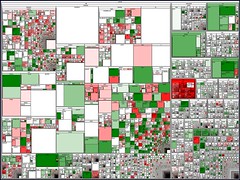
2006 MSR Netscan Usenet Treemap by number of Posts
Netscan Usenet Treemap thanks to Marc Smith

Giganews (one of the world's largest USENET providers) recently announced their reaching of 300 days retention. For those not familiar with USENET this means that if I were to post an article to USENET today, Giganews would still have that article 300 days from now (and possibly longer, as they are constantly upgrading).

AstraWeb are also at 285 days retention, and UseNetServer are currently at 282 days. AstraWeb has plans to go to 365 days and UseNetServer to 400 days. At the current upgrade rates it seems as if they are outpacing the passing of time, i.e. retention of stuff currently being posted may effectively be available forever.

So back to the headline. There's a lot of consternation as to what the business model of TV, movies and music should be. Judging by the apparent global success of the premium USENET providers it seems clear that consumers are willing to pay for content, whether or not they realise it -- premium USENET subscribers are all paying around US$15-20/month.

As far as I understand it the appeal of USENET lies in its convenience. Why mess about with BitTorrent trackers which provide variable speeds & availability when you can pay US$15-20/month to a premium USENET provider and download stuff at the full speed of your line?

One of the earliest subscription services that I remember using was Y! Music Unlimited. For US$60/year (reasonable enough, IMHO) you got access to a vast library of music but its big problem was the DRM-ed tracks. There's no shortage of evidence that consumers want DRM-free content and USENET provides that.

The current USENET experience can be significantly improved upon with a good UI - most providers only offer a pure NNTP service so you can't easily browse or search content, and users need to learn to use a reader program or 3rd party services. Additionally, streaming services could be offered. No doubt this is where the various lounge-room-centric products are headed.

The challenge of making the service legal is I guess the accounting aspect of tracking downloads in order to apportion royalties, as well as convincing all of the relevant rights holders to partcipate... (good luck).

So who will be the first to build a (legal) subscription service with a reasonable fee, offering the same breadth of content as USENET? :)

Alternatively, I wonder if more services like Usenet Binaries will start popping up. Perhaps with an accompanying TV or media-center friendly service... it could certainly be cheaper, and better, than a traditional cable TV subscription.


Recent Comments

  • Adam: Hey mate, I`m using http://www.sunvpn.com/ to watch HULU from Perth. read more
  • goosmurf: hey rifleman! :) Cheers everyone for the updates, great to read more
  • Ben B: Wow, blast from the past. Came across this post whilst read more
  • Eris: I love you! read more
  • aki: I don't agree that Facebook is an example where simplicity read more
  • web designer: A QR code (abbreviated from Quick Response code) is a read more
  • Dentall Recall Systems: I think that when Larry Page talks about start up read more
  • Paul Zagoridis: While I agree with you that slicing and dicing a read more
  • Mobile Marketer: Its strange how QR codes have never really 'taken off' read more
  • Logo Design: We are also working on expanding the key areas for read more

About this Archive

This page is an archive of entries from June 2009 listed from newest to oldest.

May 2009 is the previous archive.

July 2009 is the next archive.

Find recent content on the main index or look in the archives to find all content.